Professor Zhang Tong’s research team from the Display Technology Research Center, School of Electronic Science and Engineering, Southeast University has achieved significant progress in the research of plasmonic-semiconductor heterostructure photocatalysis. The relevant results, entitled Enhanced Photocatalytic Reactions via Plasmonic Metal-Semiconductor Heterostructures Combining with Solid-Liquid-Gas Interfaces, were published on January 18 in the top international journal Applied Catalysis B: Environmental (Impact Factor: 19.503, doi: 10.1016/j.apcatb.2022.121102). In this work, high-quality nanocrystal heterostructures were precisely designed and fabricated via a delicate technical strategy. Systematic comparative experiments uncovered unique electronic behaviors and photon-electron interaction processes within the plasmonic three-phase photocatalytic system, which were further exploited for high-efficiency photocatalysis.
Benefiting from the plasmonic hot electron effect, metal-semiconductor heterostructures enable visible-light-driven photocatalysis beyond the semiconductor bandgap limitation, emerging as a cutting-edge research direction for environmental pollutant remediation. The research team proposed a hot-electron-induced photoreduction synthesis method to construct heterojunctions between titanium dioxide and plasmonic metallic nanostructures. By tuning the surface wettability of catalytic films, a high-efficiency solid-liquid-gas three-phase photocatalytic system based on the plasmonic hot electron effect was established.
This three-phase system reconstructs and optimizes the transport channels of hot electrons at the microscopic scale, improving the utilization efficiency of hot electrons. Meanwhile, a clean oxygen source is introduced into the macroscopic catalytic system to generate abundant Reactive Oxygen Species (ROS), overcoming the shortage of reactive oxygen species in conventional solid-liquid systems and substantially boosting photocatalytic degradation efficiency.
Notably, this work adopts widely available and low-cost commercial titanium dioxide (P25) as the raw material. Plasmonic-semiconductor nanocrystals are fabricated via nanomodification on P25. The overall technical route features low cost and low energy consumption and is suitable for mass production. The as-prepared high-performance photocatalytic heterostructured nanomaterials can be widely applied to natural water purification, degradation of industrial spilled dyes and toxic organic pollutants, exhibiting great practical value and commercialization prospects for environmental pollution control. Mechanistically, the efficient band engineering and modulation of semiconductor nanostructures enabled by the plasmonic hot electron effect also provide important theoretical guidance for developing emerging electronic devices such as photodetectors and photovoltaic devices based on novel plasmonic mechanisms.
This research was supported by the National Key Research and Development Program of China (Major Nanotechnology Project) and the General Program of the National Natural Science Foundation of China. The team explores an industry-university-research integration path by conducting original research that combines advanced electronic principles, nanophotonic technologies and practically urgent social challenges, as well as cultivating professional research talents. Wang Shanjiang, a doctoral candidate at the Display Technology Research Center, School of Electronic Science and Engineering, Southeast University, is the first author of the paper, and Professor Zhang Tong serves as the corresponding author. This work was independently completed by Professor Zhang Tong’s team at the Display Technology Research Center, with Southeast University as the sole affiliation.
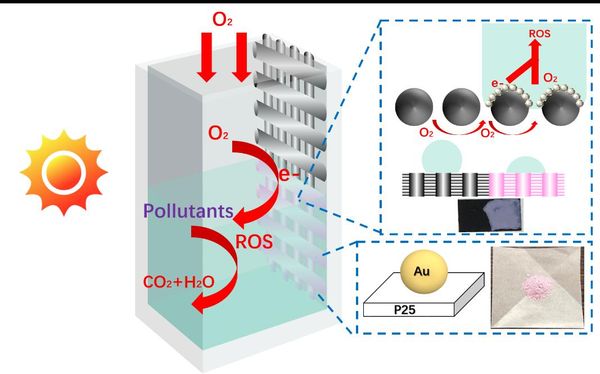
Solid-Liquid-Gas Three-Phase Photocatalytic System Based on Plasmonic Hot Electron Effect