The research work titled Solvent-free and Dispersant-free Synthesis of Narrow Full Width at Half Maximum Carbon Dots via sole precursor of p-phenylenediamine completed exclusively by the research group of Wang Chunlei and Xu Shuhong from the School of Electronic Science and Engineering, Southeast University, has been published in Materials Research Bulletin.
Carbon dots (CDs) are a new type of fluorescent material widely applied in bioimaging owing to their outstanding optical properties. Solvothermal synthesis is the most prevalent route for fabricating CDs at present. Nevertheless, CDs produced by this method generally possess a large full width at half maximum (FWHM). When such CDs are adopted for bioimaging, they are susceptible to interference from tissue autofluorescence, which degrades imaging resolution. Accordingly, the synthesis of narrow-linewidth fluorescent CDs (FWHM < 40 nm) has become a prominent research hotspot. Up to now, utilizing precursors with large π-conjugated domains to synthesize narrow-linewidth CDs has emerged as a mainstream strategy. However, an open question remains: apart from precursors with extensive π-conjugated structures, are there alternative approaches to obtain CDs with narrow-band fluorescence emission?
To address this question, the research team adopted p-phenylenediamine with a small π-conjugated domain as the sole precursor, and synthesized red-emitting CDs with an emission peak at 615 nm and an ultra-narrow FWHM of merely 29 nm via a solvent-free and dispersant-free route. Compared with solvothermal methods and solvent-free routes with dispersants, CDs fabricated by the solvent-free and dispersant-free strategy contain fewer amino groups on their surface. This effectively reduces the types of luminescent centers and ultimately achieves narrow-linewidth fluorescence emission. CDs-SF exhibit excellent biocompatibility and are applicable for rapid cell imaging without washing steps. This work marks the first fabrication of carbon dots with narrow FWHM using p-phenylenediamine as the raw material.
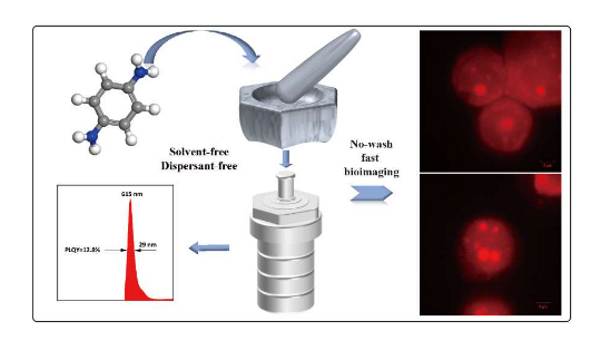
Figure 1. Schematic illustration of the solvent-free and dispersant-free synthetic strategy for carbon dots with narrow-linewidth emission and their applications.
Sun Hongcan, a doctoral candidate from the School of Electronic Science and Engineering, is the first author of this work. The research was supported by the National Natural Science Foundation of China, and received assistance from Professor Wang Zhuyuan and Associate Professor Zong Shenfei of the School of Electronic Science and Engineering, Southeast University.
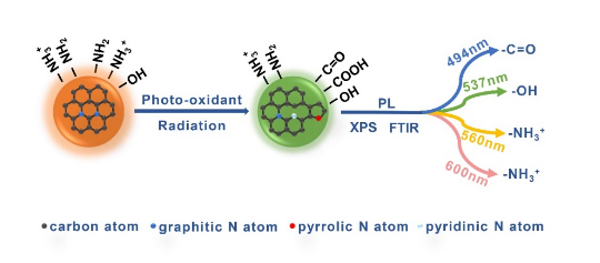
In addition, the team reported a novel post-synthetic fluorescence tuning strategy for carbon dots via photooxidation to explore the origin of luminescent centers. A photooxidant was introduced into the pre-synthesized CD solution followed by UV irradiation. This process destroys the original functional groups of CDs while generating new ones, switching the fluorescence emission color of CDs from initial orange to green. Dynamic monitoring of fluorescence spectra and functional group compositions during the photooxidation process enables precise analysis of the origin of CD luminescent centers.
Different from static characterization methods reported in other studies where CD functional groups and fluorescence remain unchanged, the proposed technique realizes dynamic characterization. By correlating the evolution of functional groups and fluorescence emission, the luminescence mechanism of carbon dots is deeply investigated from a novel perspective. The exploration of this luminescence mechanism provides theoretical guidance for the application of CDs in photocatalysis and luminescent solar concentrators.
Figure 2. Schematic diagram of post-synthetic fluorescence regulation of carbon dots.
The relevant research outcome was published in Analytical Methods under the title Post-synthetic regulating the fluorescence of CDs: giving insight into the fluorescence mechanism. Huang Qingchun, a Master’s graduate, serves as the first author. This work was supported by the National Natural Science Foundation of China, with technical support from Professor Lü Changgui from the School of Electronic Science and Engineering, Southeast University.
Link to the full text: //www.sciencedirect.com/science/article/pii/S0025540822003610