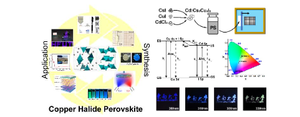
Recently, a review article entitled Recent progress of copper halide perovskites: properties, synthesis and applications by the research team of Wang Chunlei and Xu Shuhong from the School of Electronic Science and Engineering, Southeast University has been published in Journal of Materials Chemistry C, a well-known journal of the Royal Society of Chemistry (RSC). As one of the alternatives to lead-based perovskites, copper-based perovskites feature high luminescence intensity, favourable stability and non-toxicity, and have become a hot research topic in the field of lead-free perovskites in recent years. To date, copper-based perovskites have demonstrated tremendous application prospects in light-emitting diodes, photodetectors, X-ray detectors and other devices. Although numerous research reports on copper-based perovskites have been published, systematic reviews summarizing their advances remain scarce. Focusing on the synthesis and modulation of optical properties of copper-based perovskites, this paper summarizes research progress achieved in recent years. Furthermore, the review elaborates on the applications of copper-based perovskites in optoelectronic fields including light-emitting diodes, photodetectors, high-energy radiation detectors and anti-counterfeiting, and outlines existing challenges and future development directions of copper-based perovskites for optoelectronic applications.
In addition, previous relevant achievements from the team have been published in important academic journals such as Journal of Materials Science and Chemistry – A European Journal. The team first reported manganese doping of copper-based perovskites via a mechanochemical method (Journal of Materials Science, 2021, 56 (21), 12326–12335). Single-component dual-band emission originating from copper-based perovskites was realized, and the manganese impurity luminescence can be tuned within a certain range by adjusting the manganese feeding ratio. Compared with conventional doping routes requiring high temperature and inert gas atmosphere, the mechanochemical method features lower cost and enables mass production.
Moreover, the team screened impurity ions and realized excitation-dependent dual-colour luminescence by doping cadmium ions into copper-based perovskites (Chemistry – A European Journal, 2022, 28 (46), e202200877). Electrons at cadmium impurity energy levels can originate not only from the copper-based perovskite host as observed in conventional doping systems, but also from independent excitation of cadmium impurity atoms. This leads to a shift in the excitation peak of cadmium-related luminescence relative to the host copper-based perovskite. Such excitation-dependent dual-colour luminescence can be applied to anti-counterfeiting technology. As the excitation wavelength increases, the colour of anti-counterfeiting patterns changes from dark blue to light blue, and finally turns yellowish-green.
Qu Junfeng, a doctoral candidate from the School of Electronic Science and Engineering, is the first author of this work. This research was supported by the National Natural Science Foundation of China.
Paper Link 1: //doi.org/10.1039/D3TC00503H
Paper Link 2: //doi.org/10.1002/chem.202200877
Paper Link 3: //doi.org/10.1007/s10853-021-06077-9