Recently, the research team led by Professor Gu Bing and Professor Xu Chunxiang from the School of Electronic Science and Engineering, Southeast University, has achieved important progress in the research on nonlinear optical properties of two-dimensional nanomaterials. The team systematically investigated the saturation effect of spatial self-phase modulation (SSPM) in Ta₄C₃ MXene nanosheets, developed a saturated SSPM theory under intense laser fields, and successfully applied it to the construction and theoretical analysis of all-optical switches. The relevant results, entitled Saturation of spatial self-phase modulation in Ta₄C₃ nanosheets and its application to all-optical switching, were published online on April 30, 2026 in Photonics Research, an authoritative journal in optics. Ling Cheng, a doctoral candidate from the School of Electronic Science and Engineering, Southeast University, is the first author of the paper, and Professor Gu Bing is the corresponding author. This work was supported by the National Natural Science Foundation of China and the 2025 Southeast University Postgraduate Innovation Capacity Promotion Program.
As an intuitive and efficient nonlinear optical characterization technique, spatial self-phase modulation (SSPM) has been widely adopted in recent years to measure the nonlinear refractive index and third-order nonlinear susceptibility of various two-dimensional layered nanomaterials such as graphene and black phosphorus. In conventional SSPM studies, it is generally assumed that the maximum number of far-field self-diffraction rings Nmax varies linearly with the incident light intensity I.
Nevertheless, existing investigations reveal that under relatively high laser excitation intensity, the growth of Nmax slows down gradually and eventually becomes saturated as I increases. If the traditional linear fitting of the Nmax relationship is adopted to extract the nonlinear refractive index under such circumstances, deviations will be introduced into the measurement, impairing the reliability of material performance evaluation. This not only compromises the accuracy of characterizing the nonlinear coefficients of two-dimensional nanomaterials, but also exerts adverse impacts on the design, modulation efficiency and threshold evaluation of subsequent photonic devices such as all-optical switches.
Within the framework of the conventional pure Kerr model, the relationship between the maximum ring number and light intensity is described by [Formula].

To address the measurement deviations induced by linear fitting when saturation occurs in self-diffraction rings, this study develops an SSPM theory based on saturable Kerr nonlinearity. Under saturable Kerr effects, the relationship between the maximum ring number and light intensity is expressed as [Formula],

where Isat denotes the saturation intensity.
As illustrated in Figure 1, experimental measurements demonstrate that at wavelengths of 532 nm and 671 nm, three types of two-dimensional nanomaterials, namely Ta₄C₃, graphene oxide (GO) and black phosphorus (BP), exhibit similar evolutionary trends of Nmax~I versus I. As laser intensity rises, both the maximum number of self-diffraction rings and the maximum ring radius evolve from approximately linear growth at the initial stage to sublinear growth, and finally reach saturation. This result clearly indicates that the traditional SSPM analytical method based on the linear Nmax~I relationship is no longer valid under high light intensity. Nonlinear fitting of experimental data using the newly established saturated SSPM theoretical model can accurately describe the overall evolution of self-diffraction ring parameters with light intensity. The theoretically predicted variation of maximum ring radius shows excellent consistency with experimental results, verifying the applicability of the model under intense laser irradiation.
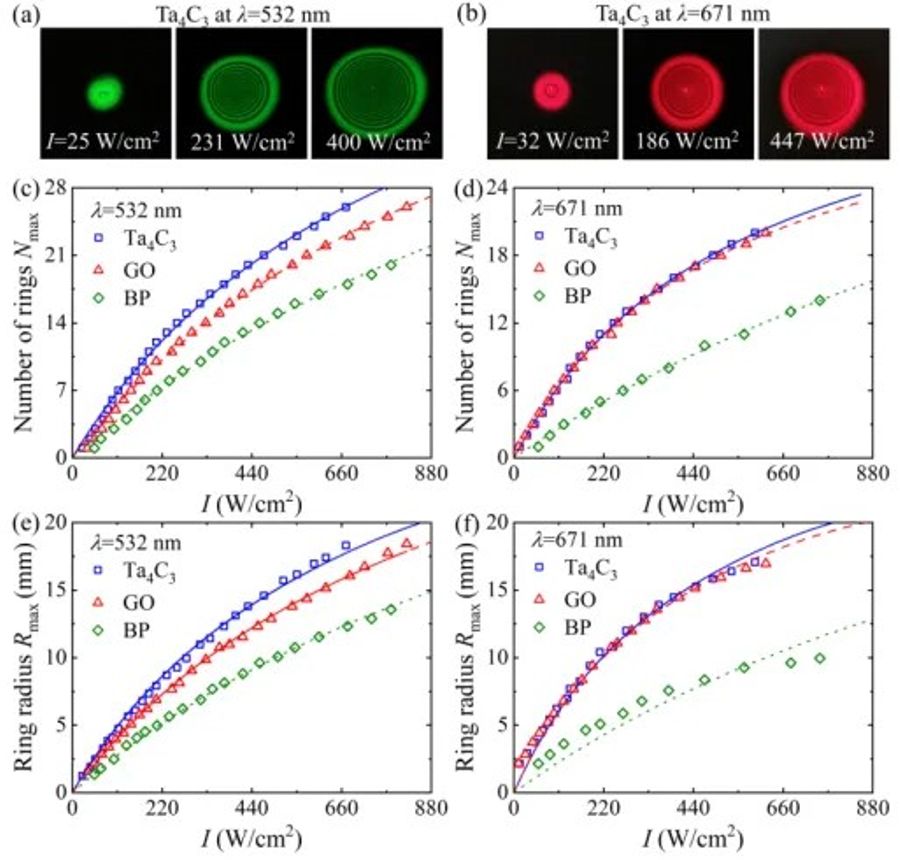
Figure 1. Evolution of self-diffraction rings for dispersions of Ta₄C₃, GO and BP nanosheets under different laser intensities, and the dependence of maximum ring number and maximum ring radius on light intensity.
Key nonlinear parameters of Ta₄C₃, GO and BP nanosheet dispersions were further extracted via the above nonlinear fitting and summarized in Table 1. It can be observed that the effective nonlinear refractive indices of the three materials are on the order of 10-6cm2/W, and the saturation intensities range from 102–103W/cm2, demonstrating typical strong third-order nonlinear optical responses.
The further calculated third-order nonlinear susceptibility of single-layer nanosheets falls within the range of 10-8–10-9esu , consistent with reported values of other two-dimensional materials. This outcome confirms that the established saturated SSPM model can not only describe nonlinear evolution processes, but also enable quantitative acquisition of multiple parameters, offering an effective approach for systematic characterization of the nonlinear optical performance of two-dimensional materials.

The authors further explained the above SSPM saturation behavior using the wind-chime model. As shown in Figure 2, under the action of the laser electric field, nanosheets dispersed in the solution experience torque and gradually undergo polarization and reorientation along the electric field direction. At high laser intensity, nearly all Ta₄C₃ nanosheets within the beam cross-section complete polarization orientation. The number of remaining responsive nanosheets in the system approaches the limit, such that the refractive index can no longer change significantly, macroscopically resulting in nonlinear saturation of the maximum number of self-diffraction rings.
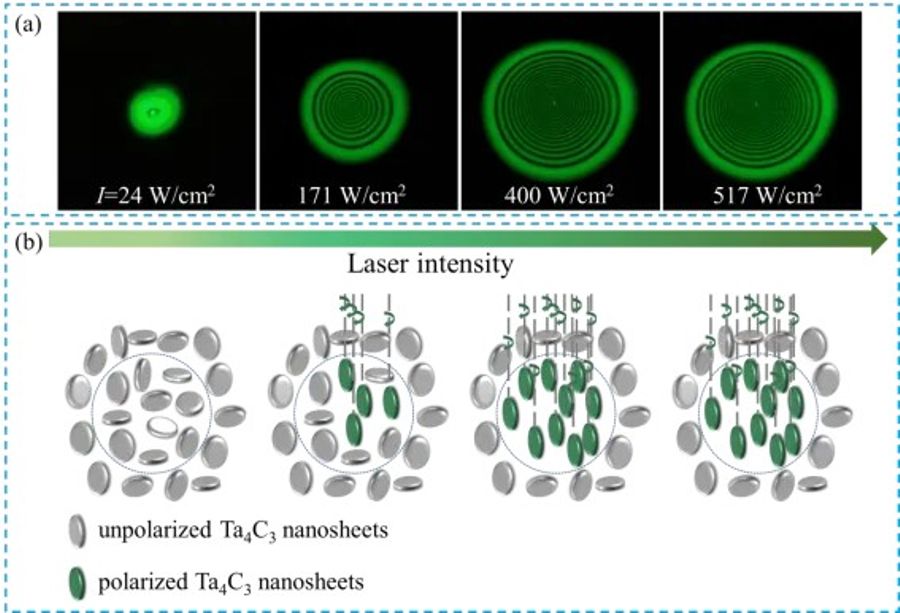
Figure 2. Schematic diagram of the SSPM saturation mechanism based on the wind-chime model.
Based on the saturated SSPM characteristics mentioned above, the authors further explored their applications in all-optical switching devices. As depicted in Figure 3, a noncollinear configuration was adopted in the experiment: a 532 nm laser served as the strong control beam, and a 671 nm laser acted as the weak signal beam irradiating the sample. When the control beam intensity is lower than the threshold for triggering SSPM, neither the control beam nor the signal beam can generate self-diffraction rings, and the switch stays in the “OFF” state. When the control beam intensity is far above the SSPM threshold, the strong control beam modulates the phase of the weak signal beam via nonlinear interaction, inducing self-diffraction rings of the signal beam under modulation by the control beam, thereby realizing the “ON” state of the all-optical switch.
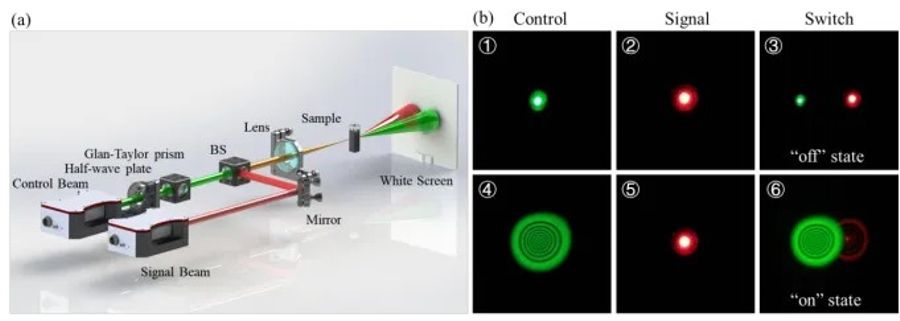
Figure 3. Schematic diagram of the experimental setup and working principle of the all-optical switch based on Ta₄C₃ nanosheet dispersion.
Dynamic test results reveal that the switching time of the device decreases nonlinearly with increasing control beam intensity. Meanwhile, similar to single-beam SSPM, the maximum self-diffraction ring number and maximum ring radius of the signal beam modulated by the control beam increase nonlinearly and gradually saturate as the control beam intensity rises. Theoretical fitting of experimental data enables extraction of saturable Kerr nonlinear parameters of the signal beam during modulation. It further proves that the SSPM saturation effect also exists in dual-beam coupling systems and imposes critical constraints on the dynamic response range and performance ceiling of all-optical switches. The results demonstrate that the SSPM saturation effect is not only an inherent feature of single-beam nonlinear processes, but also plays a vital role in all-optical devices, providing important references for the design of nonlinear photonic devices based on two-dimensional materials.
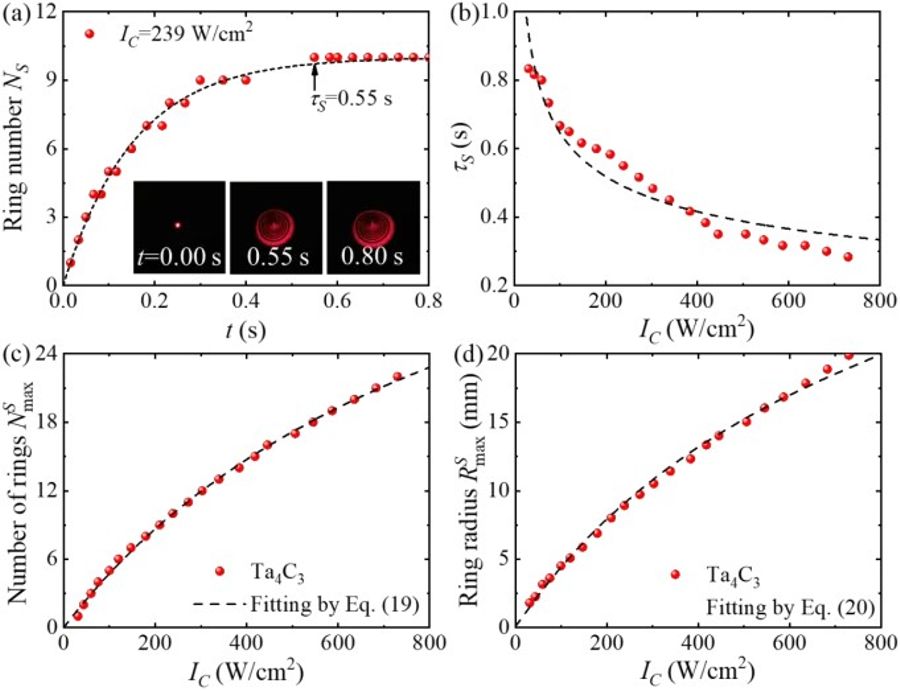
Figure 4. Performance characterization of the all-optical switch: temporal evolution of signal beam ring number, as well as the variation of switching time, maximum ring number and maximum ring radius with control beam intensity.
This work carries out systematic theoretical and experimental research on the SSPM saturation effect in two-dimensional nanomaterials. By constructing a saturated SSPM theoretical model, simultaneous precise characterization of the third-order nonlinear response and saturation intensity of materials is achieved, and the intrinsic law governing the transition of SSPM from linear behavior to saturation under high light intensity is revealed. On this basis, saturated SSPM is further extended to all-optical switching applications. Experiments verify the restricting effect of saturation on the dynamic response range and performance limit of devices, laying an important foundation for the design and optimization of relevant nonlinear photonic devices. This study not only revises the applicability limitation of conventional SSPM characterization methods under intense laser conditions, but also provides new ideas and references for the application of two-dimensional materials in all-optical modulation and nonlinear photonic devices.
Paper Link://doi.org/10.1364/PRJ.585235