Recently, the research team led by Xu Shuhong and Wang Chunlei from the School of Electronic Science and Engineering, Southeast University published a paper entitled Carbon Dots@Homogenous Matrix Composite with Room-Temperature Phosphorescence via Controllable-Carbonization Technology in SCIENCE CHINA Chemistry, with Southeast University as the sole affiliation.
Room-temperature phosphorescent (RTP) materials hold great application potential in information security, optoelectronic devices, bioimaging and other fields. At present, mainstream RTP materials are mainly organometallic complexes or transition-metal-based inorganic composites. Nevertheless, such materials generally suffer from high toxicity, high cost, complicated purification procedures and poor stability. Carbon dots (CDs) feature low toxicity, facile synthesis, low cost and tunable optical properties, making them promising candidates for novel RTP materials. A widely adopted strategy to achieve RTP emission from CDs is embedding CDs into heterogeneous matrices such as phenylboronic acid, silica gel and melamine. However, in many cases, the weak interaction between CDs and heterogeneous matrices cannot sufficiently suppress the non-radiative transition of triplet excitons, which hinders the generation of room-temperature phosphorescence. To address this critical challenge, we propose a novel strategy: constructing carbon dot-homogeneous matrix systems via controllable carbonization to achieve highly efficient room-temperature phosphorescence.
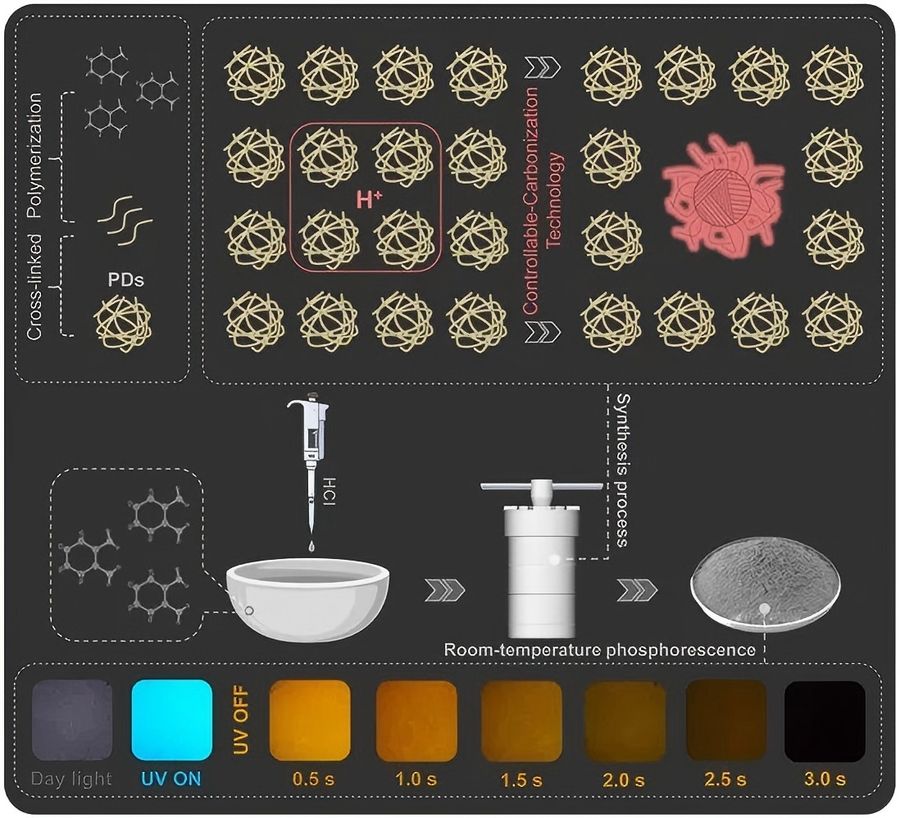
In this work, a novel carbon dots@homogenous matrix composite (denoted as CPDs@PDs) with both solid-state fluorescence and room-temperature phosphorescence was fabricated through a controllable carbonization strategy. Specifically, o-phenylenediamine precursors first polymerize to form polymer dots (PDs). Under trace acid conditions, partial PDs are carbonized into carbonized polymer dots (CPDs), while the uncarbonized PDs are uniformly dispersed as a homogeneous matrix within the system. Benefiting from the homologous nature of CPDs and PDs, they possess similar surface chemical compositions, which enables strong intermolecular π–π interactions. Such interactions not only greatly improve the color purity of fluorescence emission, but also effectively restrain the non-radiative decay of triplet excitons, thus realizing efficient room-temperature phosphorescence.
Sun Hongcan, a doctoral candidate, and Zhao Yongchao, a graduate with Master’s degree, from the School of Electronic Science and Engineering are the co-first authors of this work. The research was supported by the National Natural Science Foundation of China.