Recently, Researcher Wang Chunlei and Associate Researcher Xu Shuhong from Southeast University have published a research paper titled Integrated Device of Luminescent Solar Concentrators and Electrochromic Supercapacitors for Self-powered Smart Window and Display in the internationally renowned academic journal Nature Communications. The paper proposes a novel integrated device integrating three functions: photovoltaic energy conversion, energy storage and electrochromism, which can be applied to self-powered smart windows and information displays.
Buildings account for 30%–40% of the world’s total energy consumption. Enhancing the energy self-sufficiency of buildings has become a global consensus. Apart from deploying opaque solar panels on rooftops, photovoltaic conversion using glass curtain walls on building facades has attracted extensive research interest. As semi-transparent photovoltaic devices, Luminescent Solar Concentrators (LSCs) can harvest direct sunlight. Moreover, they can efficiently utilize diffuse reflected sunlight for photovoltaic power generation under cloudy, shaded and other low-light conditions, offering a new strategy for photovoltaic glass curtain walls on vertical facades of urban buildings suffering severe shading effects. Nevertheless, energy storage modules and voltage regulation circuits are required to store electricity generated by LSCs. These additional components reduce the effective active area of LSCs and demand extra installation space, limiting their practical deployment in photovoltaic curtain walls.
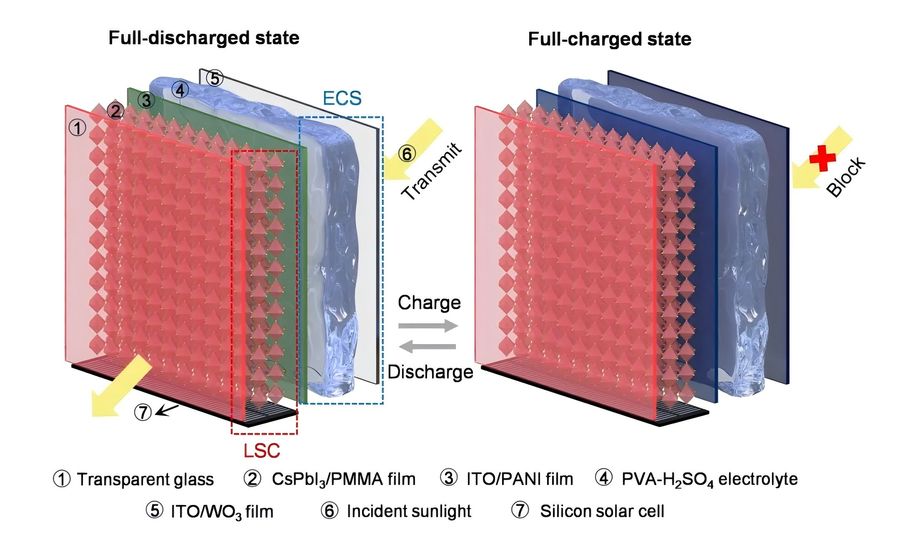
To tackle this challenge, the research team developed a face-to-face integrated device combining LSCs and Electrochromic Supercapacitors (ECSs). By adopting electrode pairs with matched voltage windows, the photovoltaic electricity generated by LSCs can be directly stored in ECSs without auxiliary energy storage and voltage regulation modules. This design substantially increases the effective working area and cuts down costs. ECSs feature both energy storage capability and reversible electrochromic performance; their transmittance of visible and near-infrared light can be dynamically modulated according to stored electric charge. By regulating the charging and discharging of ECSs, the integrated device can serve as a self-powered electrochromic smart window or information display. This innovative monolithic device integrating photovoltaic conversion, energy storage and electrochromism provides an efficient and multifunctional alternative for building smart windows.
Huang Shichao, a doctoral student from the School of Electronic Science and Engineering, Southeast University, is the first author of the paper. Researcher Wang Chunlei and Associate Researcher Xu Shuhong from the same school are the co-corresponding authors, and Southeast University acts as the sole corresponding institution. This work was supported by the National Natural Science Foundation of China.
Paper Link://doi.org/10.1038/s41467-025-57369-6